What corner flashings do on a building
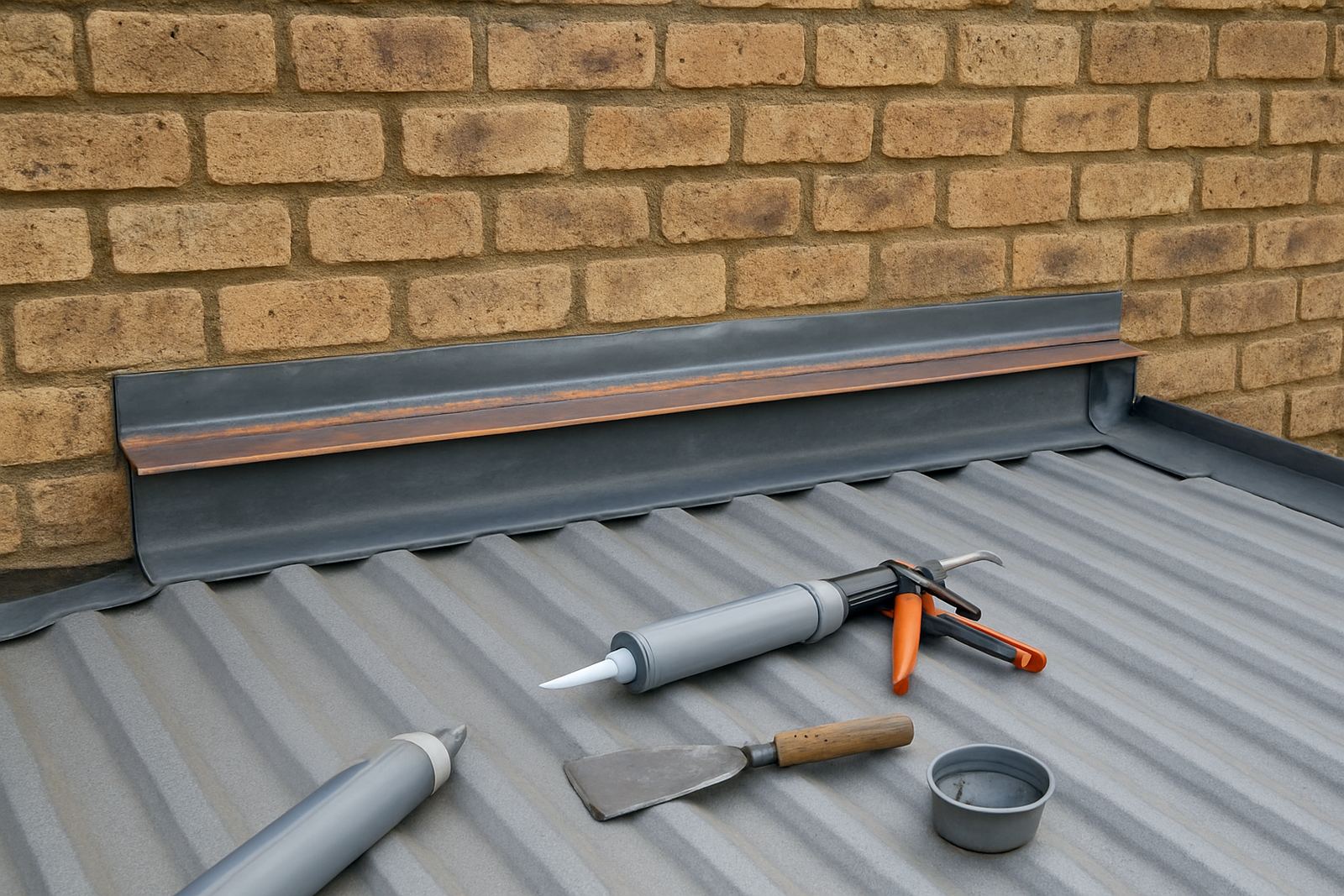
Corner flashings are folded metal trims fitted to outside and inside corners where sheet metal panels change direction. On a roof and wall junction they cover the joint, shed water away from the gap, and help stop dirt and wind driven rain from working into the lining. On coastal work around Mossel Bay, Hartenbos and Great Brak River, that matters because salt air and gusty weather can find any weak point. A good flashing does not only look tidy, it helps the cladding and roof system last longer.
We supply corner flashings for steel buildings, storage sheds, garages, carports, boundary walls and light commercial work. They are often used with wall cladding, roof sheeting, parapet details and fascia lines. The profile is folded to suit the angle on site, so the piece sits cleanly without forcing the sheet work out of line.
Sizes, profiles and finish options
Most corner flashings are made to order from galvanised steel, pre-coated sheet or aluminium depending on the project and exposure. The usual folded leg sizes range from 75 mm x 75 mm up to 150 mm x 150 mm, with longer return legs available for deeper cladding ribs or irregular wall lines. Typical sheet thicknesses are 0.47 mm, 0.53 mm and 0.58 mm, though heavier gauges can be supplied where the corner needs more body. Lengths are usually supplied in 2.4 metre, 3 metre or 6 metre sections, and can be cut to suit on site.
For buildings near the coast we often advise a material choice that handles humidity and frequent wind. If the corner will be visible from the street or driveway, the finish is matched to the roof or wall sheets so the whole line looks consistent. If the detail is hidden behind a parapet or inside a service area, the main concern is weather performance and fixing access, not appearance. We can also fold special angles for non-standard corners, because not every wall lands at a neat 90 degrees.
- Outside corner flashings for cladding edges
- Inside corner flashings for enclosed returns
- Parapet and roof transition flashings
- Custom folded angles for unusual corners
Where corner flashings suit best
Corner flashings suit new steel buildings, extensions, workshop units, farm sheds and domestic improvements across the southern Cape. They are especially useful where cladding turns a corner, where two roof planes meet a wall, or where a roof sheet finishes against a brick or concrete structure. In places like George and Wilderness, where rain can come in hard and sideways, the right corner detail helps protect the opening around the join. On a carport or lean-to, it keeps the edge from lifting visually and gives the roof a proper stop line.
They also work well on maintenance jobs. If the old corner trim has rusted, loosened or started letting in water, a replacement flashing can often be made to the same size and fitted without changing the full cladding run. That saves time and avoids unnecessary strip-out. For industrial sites, the same principle applies to wall corners, access points and plant room enclosures where water ingress can cause staining, corrosion or damage to stored equipment.
- Steel sheds and light industrial buildings
- Carports, awnings and shade structures
- Wall cladding transitions and roof terminations
- Repair work on leaking or damaged corners
How we measure and fabricate corner flashings
We start with site measuring so the legs, angle and overlap suit the actual building line. That matters because a corner flashing that is 10 mm too short or folded to the wrong angle can leave a gap or pull the sheet out of line. Our workshop team folds the piece to the required dimensions, then checks the straightness of the return and the consistency of the bend before dispatch. On bigger jobs we work from a set-out plan, and on smaller repairs we can match an existing profile from a sample piece.
Installation normally needs standard sheet-metal tools, screw fixings, sealant and safe access equipment. No heavy power is needed for the flashing itself, but on site the crew may need drilling gear, cordless drivers and, where the corner is high, proper access scaffolding or a suitable work platform. For roofing and cladding work, a gas torch is not normally used on these trims. If a customer is asking for a sealed detail around a heat-sensitive area, we look at the fixings and sealants instead of heating the metal. That keeps the finish neat and reduces risk.
- Measure the corner angle, not just the wall length
- Check overlap with the roof sheet or cladding profile
- Confirm fixing points before fabrication
- Plan safe access for installation on higher work
Fitting, sealing and weather protection
A corner flashing performs best when it is fixed onto a clean, sound surface. Before installation, loose rust, old sealant and trapped dirt should be removed. The flashing is then fitted with the correct overlap, and fixings are spaced so the piece does not wave or twist in the wind. On exposed coastal sites, small details matter a lot: screw washers should seat properly, laps should face away from the prevailing weather where possible, and sealant should be applied where the joint needs extra protection. If the building has existing movement, expansion allowance may be needed so the flashing is not forced to crack or lift.
For roof and wall transitions, the corner piece is often combined with other custom flashings so water is directed down and away from the opening. Where gutters meet a corner or a parapet returns into a wall, the detail may need a matching stop-end or apron piece. We look at the full junction, not only the visible edge, because water often finds the smallest path. On some repairs the cause of a leak is not the corner itself but the sheet overlap above it, so a proper inspection saves guesswork and repeat callouts.
Care, servicing and what to check before ordering
Corner flashings do not need much attention, but they should be checked during roof or building maintenance, especially after strong wind, heavy rain or a long summer of coastal moisture. Look for lifted screws, cracked sealant, early rust, dents from ladders or debris, and any staining on the wall below the corner. If a building is near the sea or under trees, rinse-off and cleaning may be needed more often to remove salt and grime. A quick inspection every few months can prevent a small gap from becoming a leak.
Before ordering, it helps to have the corner angle, visible leg sizes, total length and the material finish. Also check whether the piece needs to sit over cladding ribs, under a roof sheet edge, or against a masonry return. If there is an existing flashing, bring a sample or clear photo with a tape measure in shot. That makes matching easier and helps avoid delays. When the site is on a steep roof or a tight boundary line, tell us early so the fixing method and access can be planned properly. A few minutes of checking now saves rework later, and that is always worth it.
- Measure both legs and the angle of the corner
- Confirm material type and finish
- Check if the flashing must match an existing profile
- Note any access limits, height or safety issues
Key facts
| Product type | Internal and external corner flashings for cladding and roof transitions |
|---|---|
| Material options | Galvanised steel, pre-coated sheet, aluminium |
| Typical thickness | 0.47 mm, 0.53 mm, 0.58 mm, heavier on request |
| Common leg sizes | 75 mm x 75 mm, 100 mm x 100 mm, 150 mm x 150 mm |
| Standard lengths | 2.4 m, 3 m and 6 m, cut to size on request |
| Typical use | Steel buildings, carports, wall cladding, roof terminations and repair work |