Why roof penetrations leak first
Any opening through a roof is a risk point. Vents, flues, antenna brackets, extractor outlets, pipes and service conduits all break the surface of the sheet or tile, which means the weather has one more place to get in. If the flashings are too small, badly shaped or fixed with the wrong fasteners, water will track under the roofing and into the ceiling space.
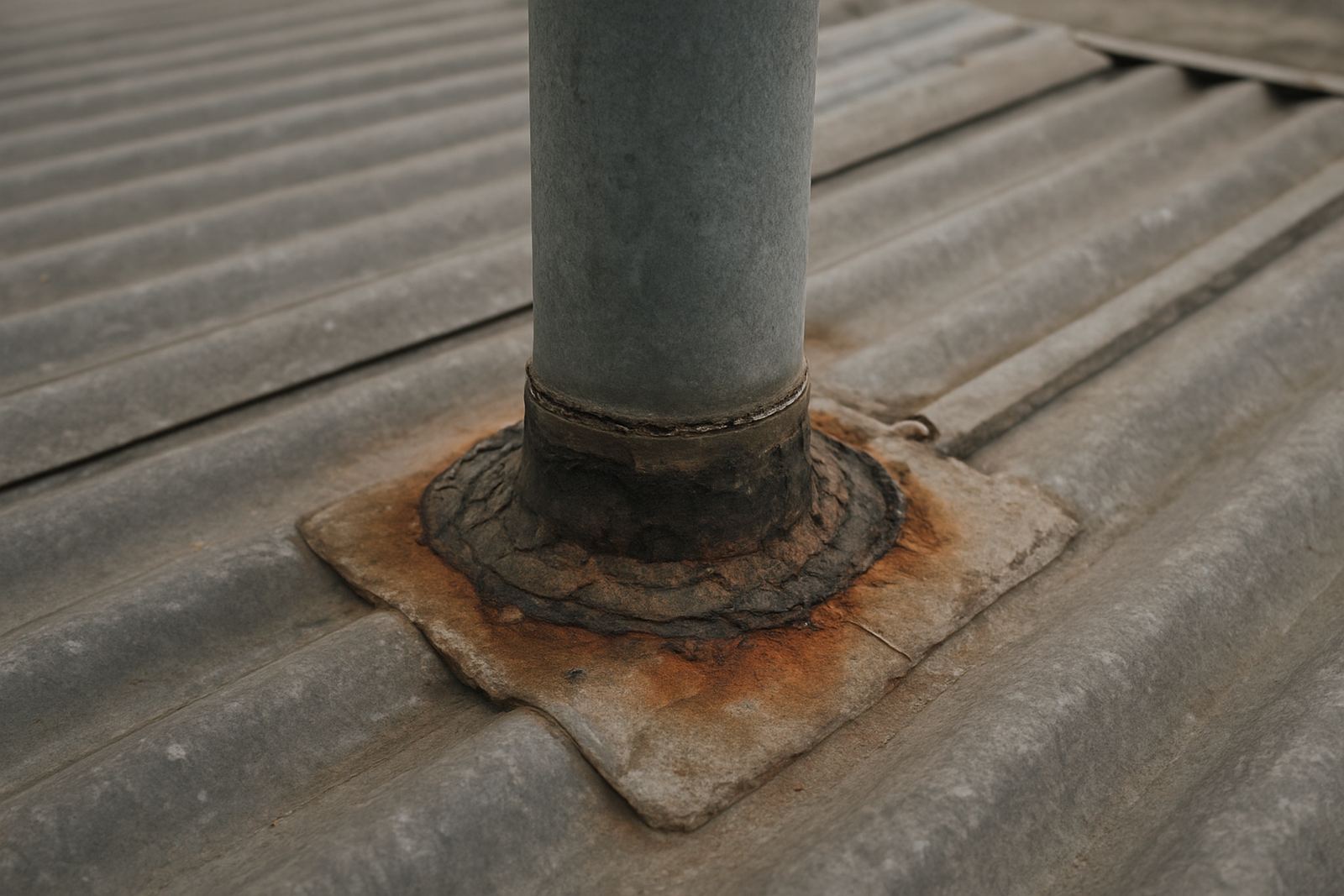
On sheet-metal roofs, the problem often starts where the penetration sits on a corrugation or rib. On tiled roofs, the seal around the pipe or cowl can harden and crack. Coastal moisture in Mossel Bay and Hartenbos makes this worse because metal parts corrode faster, and once a seal goes, a small gap can let in plenty of water during a south-easter.
Common leak points we see on southern Cape roofs
When we inspect a leaky roof in Gouriqua Park, Great Brak River or George, the same areas come up again and again. The issue is not always the penetration itself. Sometimes the leak is at the fixing point, the overlap, or the place where old sealant has lifted.
- Plumbing vent pipes with brittle rubber boots
- Flues from geysers or fireplaces with undersized flashings
- Aircon pipes and electrical service penetrations
- Roof hatch edges and cowl bases with loose fasteners
- Valley areas where runoff pools around a penetration
- Rust holes near old self-drilling screws or washers
If there is dust streaking, rust trails or brown marks on the ceiling below the opening, the water path is often higher up than people think. Sometimes the leak only shows up after a night of wind and rain, then disappears before the next visit, which makes it easy to miss if no one checks properly.
How to spot trouble before the stain gets bigger
Most roof penetration leaks give a few warning signs before they become a proper mess. A musty smell in the roof space, bubbling paint, damp insulation, or rust around a collar are all worth checking. In houses and light industrial units, we also look for cracked sealant, lifted flashing edges, and fasteners that have worked loose from vibration and heat.
- Brown marks on ceilings after heavy rain
- Drips near walls but no clear leak line
- Flashing that moves when touched
- Cracked mastic or old sealant around the pipe
- Rust around screw heads, washers or cut edges
- Water pooling on low-pitch sections of roof
A quick visual check helps, but it should not be the only check. A penetration may look fine from the ground and still fail once wind pushes rain sideways under the lip. That is why a proper inspection on the roof matters, especially on older work where the original installation was done years ago.
What a proper repair should include
A lasting repair is not just a blob of sealant. The right fix depends on the roofing profile, the size of the opening and the type of service passing through. We measure the point, check the fall of the roof, and make sure the flashing sheds water away from the opening instead of holding it against the roof sheet.
Good repairs often include a new custom flashing, correct sealing at the base, replacement of corroded fixings and, where needed, localised roof sheet work. If the surrounding roof steel is thin or pitted, the area may need more than a patch. In coastal areas, old galvanised parts can start to fail from the edges first, so it makes sense to replace the worn section before it starts leaking again.
For service penetrations on homes and small businesses, we also check whether the pipe or duct moves in the wind. Movement can tear a seal open over time. A repair that allows for a bit of movement usually lasts longer than one forced rigidly into place.
Local conditions in Mossel Bay make maintenance matter
Mossel Bay roofs deal with salt air, sudden rain, strong sun and sometimes long dry stretches between storms. That cycle is hard on rubber seals, mastics and thin sheet metal. In places like Wilderness and Sedgefield, where humidity stays high, sealant can look fine on top but still lose grip underneath. In George and the inland side of the southern Cape, temperature changes can also pull at the flashing every day.
On the coast, we often see small service penetrations ignored until a ceiling starts staining after winter rain. A quick maintenance inspection once or twice a year can catch loose fixings, cracked collars and tired flashings before they become a claim or a costly interior repair. It is cheaper to change a small part than to fix a soaked ceiling board and damaged insulation later.
How we deal with penetration leaks on site
Our approach starts with site measuring and a close look at the roof type, pitch and access. We do not treat every leak the same because a flue on a carport roof is not the same as a pipe on a steel building. Once we know what is failing, we make or replace the flashing, repair the surrounding roof area and check the gutters and run-off path nearby.
In one case near Hartenbos, a homeowner had a drip above the passage ceiling every time the wind came from the sea. The problem turned out to be a service penetration with a split seal and a slightly lifted flashing edge. The roof sheet itself was still sound, but the water was finding the smallest gap. After the repair and a follow-up inspection, the leak stopped and the ceiling dried out. That kind of job can look small from the outside, yet it saves a lot of trouble inside.
When to call for an inspection
If you see a stain near a vent, smell damp in the roof space, or notice rust around a pipe or flue, it is time to get it checked. Do not wait for the next heavy storm. Penetration leaks can spread into insulation, timber, plaster and electrical points if they are left alone.
We handle roof leak repairs, custom flashings, gutter work and maintenance inspections across Mossel Bay, Gouriqua Park, Great Brak River, George, Wilderness and Sedgefield. If you need a proper look at a leaking penetration, it helps to deal with it early while the fix is still simple.